Web App Product Design UX Research

Flow & RFI Builder

A centralized web platform that replaced Excel spreadsheets and email chains for managing retail media evaluation cycles — cutting multi-week processes down to days for Coca-Cola and 100+ retail partners.

Role

Lead UX/UI Designer

Users

Commerce + Retail teams

Partners

100+ retailers

Platform

Web App

Year

2023

Timeline

4-month MVP

Hero screenshot flow-hero.png

Impact at a glance

Weeks

→ Days. RFI cycle time cut dramatically

100+

Retail partners onboarded onto one platform

1

Source of truth replacing scattered Excel files and email threads


The problem

Excel and email — for enterprise-scale decisions.

GroupM's commerce team ran their entire RFI process through spreadsheets and email threads. Coca-Cola and 100+ retail partners were exchanging documents manually — no shared workspace, no version control, no visibility into where any evaluation stood. This was 2023.

Cycles that should take days stretched to weeks. There was no centralized way to know which retailers had completed and returned an RFI, or whether their data had even been ingested. Leadership couldn't see pipeline status without chasing someone down.

"Designing for two very different users — the brands sending RFIs and the retailers receiving them — meant every screen had to serve two mental models at once."


Solution

Two options. One constraint that decided it.

Before wireframing anything, the team evaluated two approaches to the core problem. The 4-month MVP window made the decision straightforward.

Option 1 — Excel + upload link

Send the existing Excel RFI automatically

Flow would email the Excel file to all partner retailers. Retailers fill it out, then upload the completed file via a link. Data then lives in the platform. Lower build effort upfront, but required custom data parsing for every retailer submission.

Option 2 — Web-based RFI

Build the RFI natively in the platform

Retailers receive a link and fill out the RFI directly in a web form. Data lands in the platform automatically, no parsing required. More upfront design work, but cleaner data and no dependency on file handling.

✓ Chosen for MVP

Product and engineering agreed: data parsing for Option 1 was too time-consuming to build within four months. Option 2 meant more design work upfront, but data would live in the platform automatically from day one. That was the right trade-off.


Discovery

Two users. Two very different mental models.

Stakeholder interviews revealed the biggest pain wasn't the data itself — it was the handoff moments: sending, receiving, following up, confirming completion. That's where Flow had to be airtight.

Brand side — Coca-Cola

Create, send, track, report

  • Build and send RFIs to 50+ retailers
  • Set deadlines and track response status
  • Export results for leadership reporting
  • See live completion rates at a glance

Retailer side — Partners

Receive, respond, submit

  • Understand what's being asked quickly
  • Respond inline and save drafts
  • Submit with a clear confirmation
  • No training needed to use it

Design

One platform, two clear experiences.

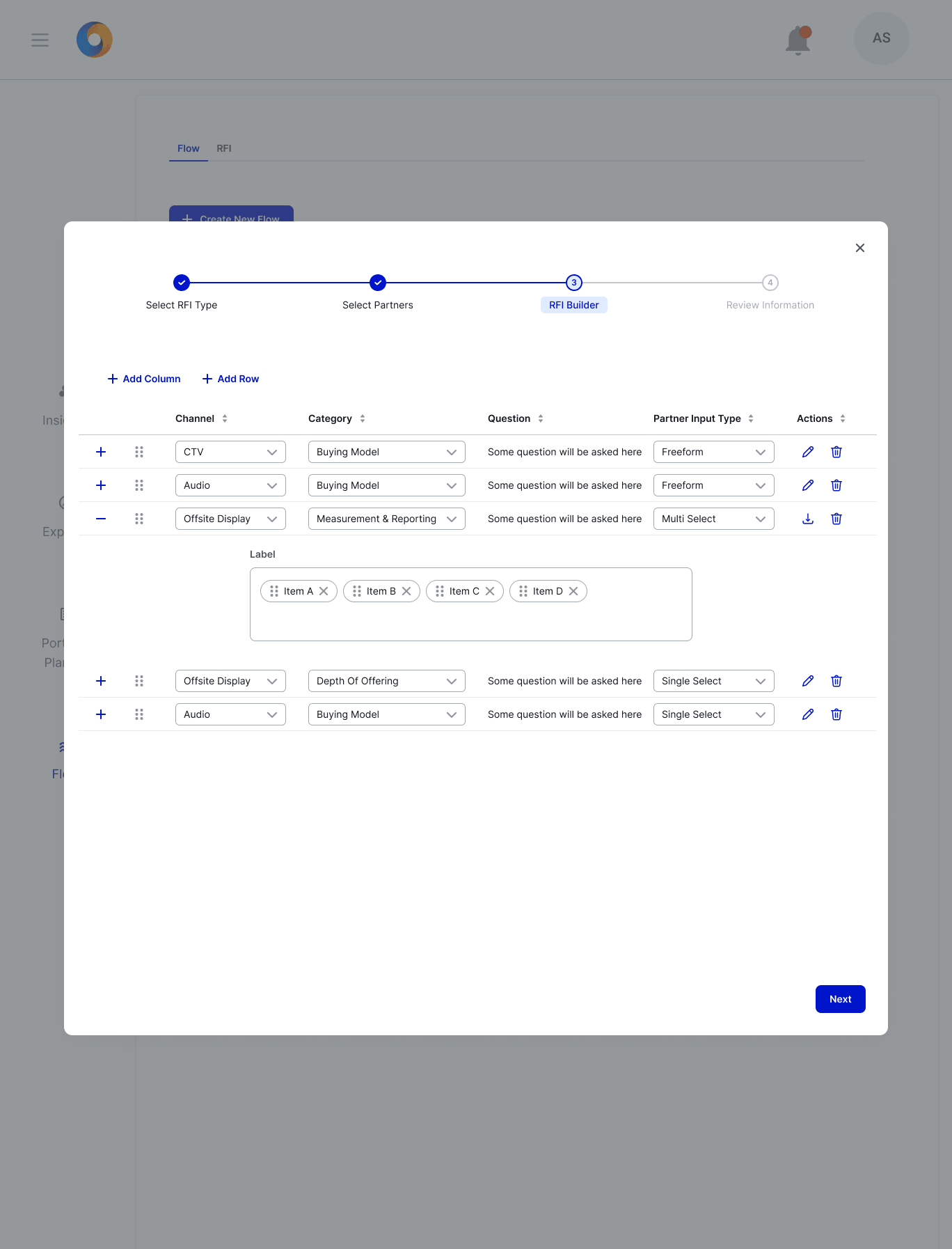
RFI Builder — a step-by-step guided flow for brand teams. Section-by-section structure, deadline setting, and retailer assignment in one place. The builder itself is table-based: admins add rows and columns and configure each question type inline. RFIs contain a mix of short answer, long answer, single select, and multi-select questions, so the builder needed to handle all of them without requiring a custom question editor. Following the WPP Design System kept the implementation within scope for the 4-month timeline.

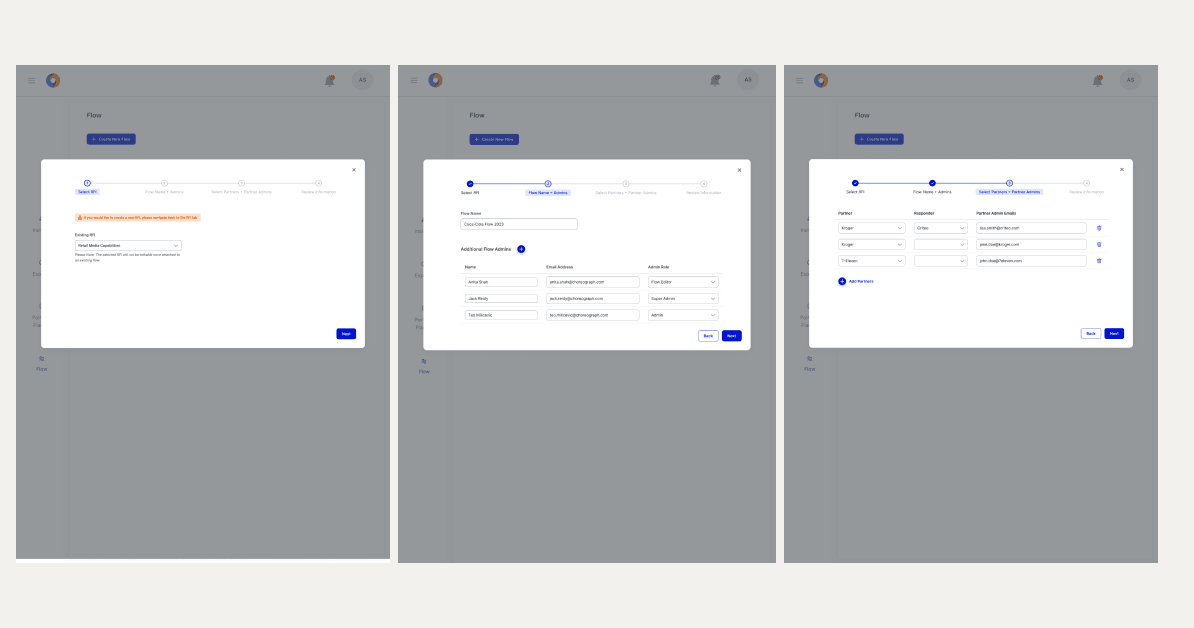
Clone RFI was a must-have. Many clients share the same retailers and commerce capabilities across evaluation cycles. Rebuilding from scratch each time would have eliminated most of the efficiency gain. One click to duplicate and adjust.

Admin permissions — not everyone on the commerce team needed access to every Flow. Designing the role assignment step (who gets admin access to which Flow and at what level) was a separate design problem built into the creation stepper, not a separate settings page. Keeping it in context meant it rarely got skipped.

Retailer response view — stripped back and task-focused. Retailers see exactly what is being asked, respond inline, save drafts, and submit with a clear confirmation state.

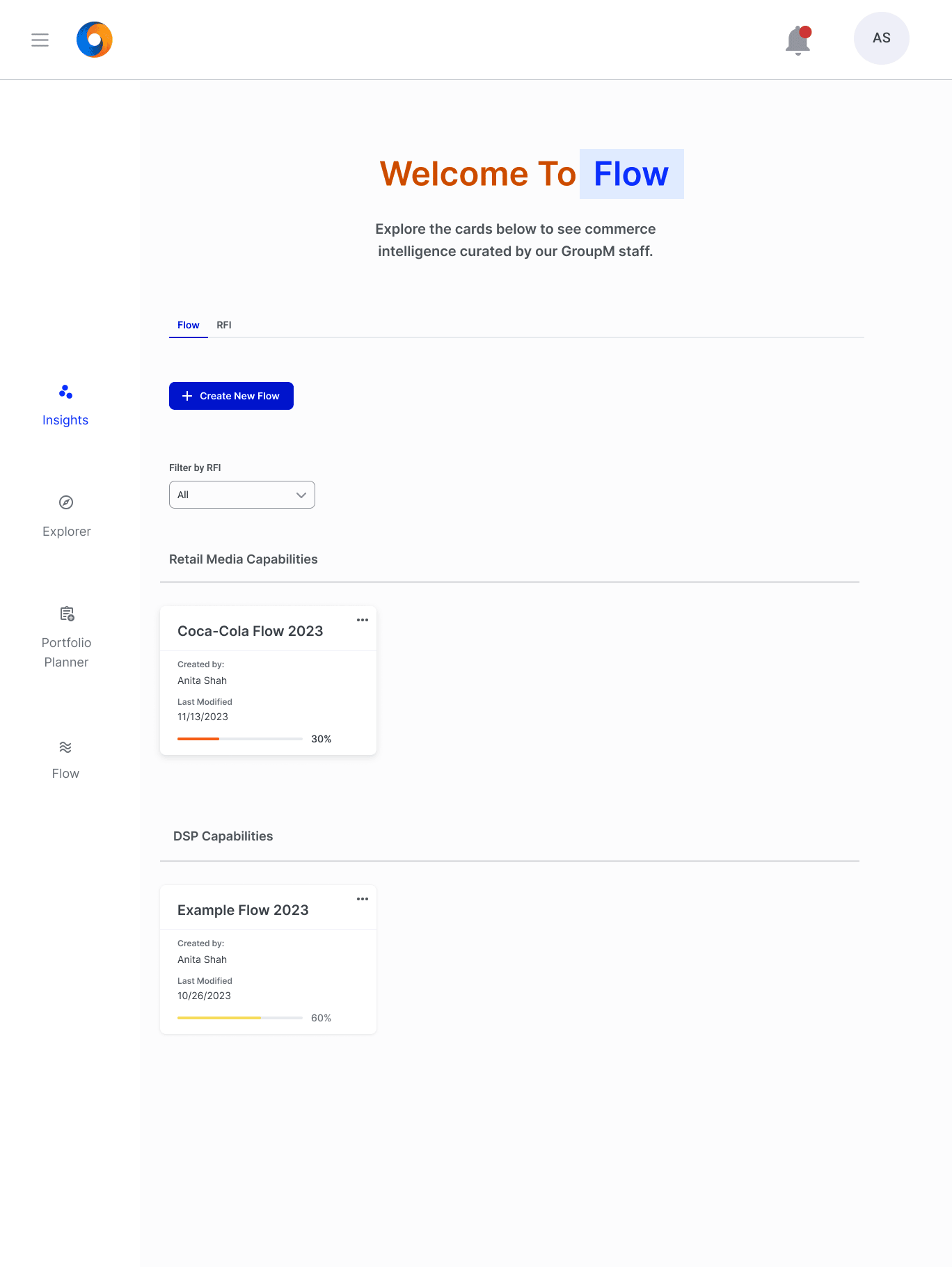
Status dashboard — live view of every active RFI, response rates per retailer, and overdue flags. Leadership visibility without needing to ask anyone.

RFI Builder — brand view flow-builder.png
Response view — retailer flow-response.png
Status dashboard flow-dashboard.png

Iteration

One long form, two problems, one clear fix.

The original RFI Builder put every question on a single page. In early testing with GroupM's brand-side clients — teams at Coca-Cola and Nestlé — three problems surfaced immediately: the page felt impossible to scan, users lost their place when they stepped away, and the visual experience didn't meet the expectations of enterprise-level software.

The fix was to restructure the experience into a guided multi-step flow — questions broken into logical groups, one section at a time, with a step indicator showing progress. Usability feedback shifted from frustrated to confident, and the form no longer felt like a wall of work.

V1 — Single page

All questions at once

↕ scroll for more

Every question visible at once. Users couldn't gauge scope, lost context on return, and felt the form was longer than it needed to be.

V2 — Multi-step flow

One section at a time

1

Questions grouped into focused steps. Clear progress, logical pacing. Users knew where they were, what was next, and how much was left.

✓ Shipped

"The long form wasn't a layout problem — it was a trust problem. Users couldn't see the end, so they didn't know what they were committing to. Breaking it into steps gave them that clarity."

A second refinement from the same round of testing

V1 — Status tags

Per-retailer status

Each row showed a tag: Sent, In Progress, or Complete. Required scanning the whole list to understand overall cycle progress.

V2 — Progress bar

Cycle-level completion

A single progress bar per RFI showing % of retailers completed. Instant at-a-glance status without scanning every row.

✓ Shipped

Reflections

What I took from this project.

Design for the handoff

The hardest UX problems weren't in the core flows — they were in the moments between. Getting sends, confirmations, and status updates right was where trust was built.

Two users, one system

Keeping brand and retailer experiences distinct while sharing the same data model required constant alignment with engineering on how state was managed.

What I'd add

A proper email notification layer — a lot of follow-up still happened outside the app. Bringing that communication into the platform would have closed the loop completely.

Build vs. buy

We evaluated third-party RFI tools before building. The decision to build was right — no off-the-shelf tool could handle the GroupM-specific workflow and partner scale.